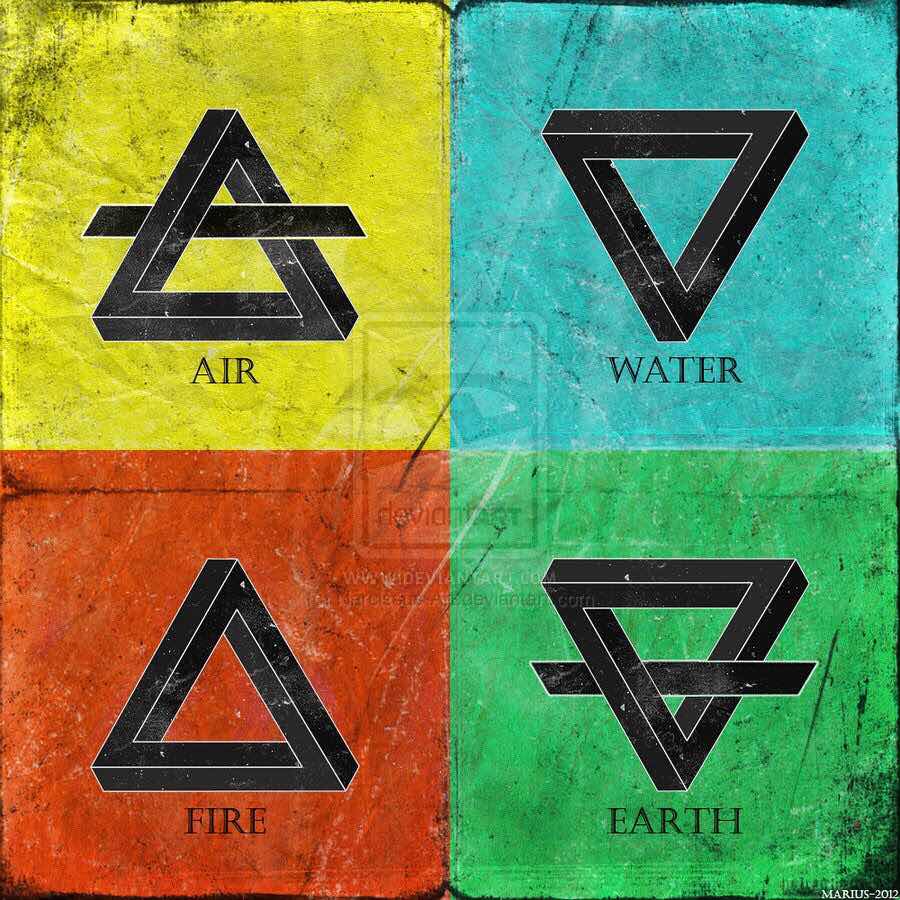
The Four Elements
For thousands of years, people have looked to the natural world to understand the forces that shape life. Among the oldest and most enduring ideas is that everything around us is connected to four fundamental elements: Earth, Water, Air, and Fire.
The ancient Greeks believed these four elements were the building blocks of the world. In fact, cultures across the globe have developed their own symbolism, traditions, and beliefs surrounding Earth, Water, Air, and Fire.
It’s easy to understand why these four elements have held such significance. They sustain life and make our existence on this planet possible. Remove any one of them, and life as we know it could not exist.
The Greek philosopher Aristotle expanded upon the idea of the four elements around 450 BCE, describing them according to qualities such as hot, cold, wet, and dry. Centuries later, alchemists developed the familiar triangular symbols we still associate with the elements today.
Fire
Fire is the element of transformation, energy, and light.
Often associated with the Sun, Fire is considered warm and dry. Its light pushes back the darkness of night, while its heat provides warmth and energy.
Fire is never truly still. It changes whatever it touches, transforming one thing into another. It can destroy, but it can also create, renew, and inspire. When combined with other elements, its nature can change and intensify. Give Fire air, for example, and its flames can grow larger and burn brighter.
Fire reminds us that change, while sometimes unsettling, is also a natural part of life.
Water
Water is the element of emotion, healing, cleansing, and renewal.
Cool and flowing, Water has long been associated with calmness and peace. It can soothe the body, quiet the mind, and wash away what is no longer needed.
We find Water everywhere: in oceans and seas, lakes and rivers, streams and springs, and in every living thing. From the tiniest microorganism to the largest mammal, all life depends upon it.
Water is also endlessly adaptable. It flows around obstacles, changes its form, and continually moves through the natural world. Perhaps that is why it has become such a powerful symbol of cleansing, purification, renewal, and the ability to adapt.
Air
Air is the element of life, movement, thought, and freedom.
Every living creature depends upon Air. Plants and animals alike require it to survive and thrive, making Air one of the most fundamental forces of life.
We cannot see Air itself, but we know it through its movement—the gentle touch of a breeze, the strength of the wind, or the breath within our own bodies.
Air has traditionally been associated with the mind, communication, inspiration, and the movement of energy. Like our thoughts, it is constantly moving and changing, surrounding us even though we cannot hold it in our hands.
Every breath is a quiet reminder that we are part of the natural world.
Earth
Earth is the element of grounding, stability, nourishment, and life.
Of the four elements, Earth is perhaps the one we experience most directly beneath our feet. Its cool and solid nature provides a foundation for everything that lives and grows.
Earth is found in fields and forests, hills and mountains, valleys and plains. It gives plants a place to take root and provides the soil from which food and nourishment emerge.
Everything we eat ultimately comes from the Earth. Every home, every forest, every garden, and every living creature is connected to it in some way.
Earth reminds us of our roots and our connection to the physical world. It represents stability, patience, fertility, and abundance—the quiet foundation upon which life is built.
A Living Balance
Earth, Water, Air, and Fire are more than ancient symbols. They offer us a way of looking at the natural world and recognizing the countless ways these forces interact with one another.
Earth gives us a place to stand.
Water gives us life.
Air gives us breath.
Fire gives us warmth and transformation.
Together, they remind us that we are not separate from nature. We are part of it.
