We are so ready for this...
According to Amanda’s Cooking, the English didn’t “invent” the trifle, the Scottish did. The Scots have recipes that date back to the late 1500’s.
But, since Scotland and England united to become the United Kingdom, calling the trifle “English” is accurate enough.
This recipe is wonderful, borrowed from Amanda’s Cooking at:
Ingredients
CUSTARD LAYER
4 cups whole milk
1/2 cup heavy cream
1 teaspoon vanilla extract
8 egg yolks
4 tablespoons sugar
2 tablespoon cornstarch
CAKE LAYER
9x13 white or yellow cake, baked and cooled
1/2 cup cream sherry
3 heaping tablespoons seedless red raspberry jam or preserves
FRUIT LAYER
2 cups sliced fresh strawberries
1 cup fresh raspberries
1 tablespoon cream sherry
1 tablespoon sugar
WHIPPED CREAM
1 1/2 cups heavy whipping cream
1 teaspoon powdered sugar
Instructions
For the Custard
Combine the milk, heavy cream and vanilla in a heavy bottomed medium saucepan, stirring frequently.
Heat the milk mixture over low-medium heat until it just begins to simmer and steam rises from the surface.
Meanwhile, mix the sugar and cornstarch together with a fork. In a large mixing bowl, whisk together the egg yolks and the sugar mixture until light and smooth.
HINT: I use my KitchenAid for this, but only as a stand.
I hand whisk but use the bowl of the mixer attached to the machine so that I don't have to hold the bowl as well.
This allows me to whisk and pour at the same time, which is needed in the next step.
Remove the warmed milk from the stove and while whisking the egg yolks constantly, dribble a few drops at a time into the yolks. Adding the hot liquid very, very slowly in the beginning will temper the eggs, allowing them to warm gradually so that they don't curdle, or worse, scramble!
Once you have dribbled in a good amount you can increase the amount of liquid you add at a time, whisking continuously until all the milk has been added.
Pour the contents of the mixer bowl into the saucepan and heat over medium, stirring constantly.
Keep stirring, ensuring that the milk mixture does not stick to the bottom of the pan, until thickened, anywhere from 2-6 minutes.
Custard will be thick and smooth.
Pour into a shallow bowl and cover the top with plastic wrap so that the plastic is touching the surface of the custard.
This will prevent a skin from forming on top.
Cool in the refrigerator until chilled.
For the Cake
Cut the cake into large manageable squares.
Cut those squares in half horizontally.
Open the squares so that the cut sides are facing up.
Brush the cake with the cream sherry.
Spread the sherries cake with the raspberry jam.
Cut the cake into cubes.
For the Fruit
In a medium bowl, combine the strawberries, raspberries, sherry and sugar.
Stir to coat and allow to macerate.
Keep in the refrigerator until ready to assemble the trifle.
For the Whipped Cream
Combine the heavy whipping cream and the powdered sugar in a larger mixer bowl.
Beat on high for 2 minutes, or until stiff peaks form.
Keep chilled in the refrigerator until ready to assemble.
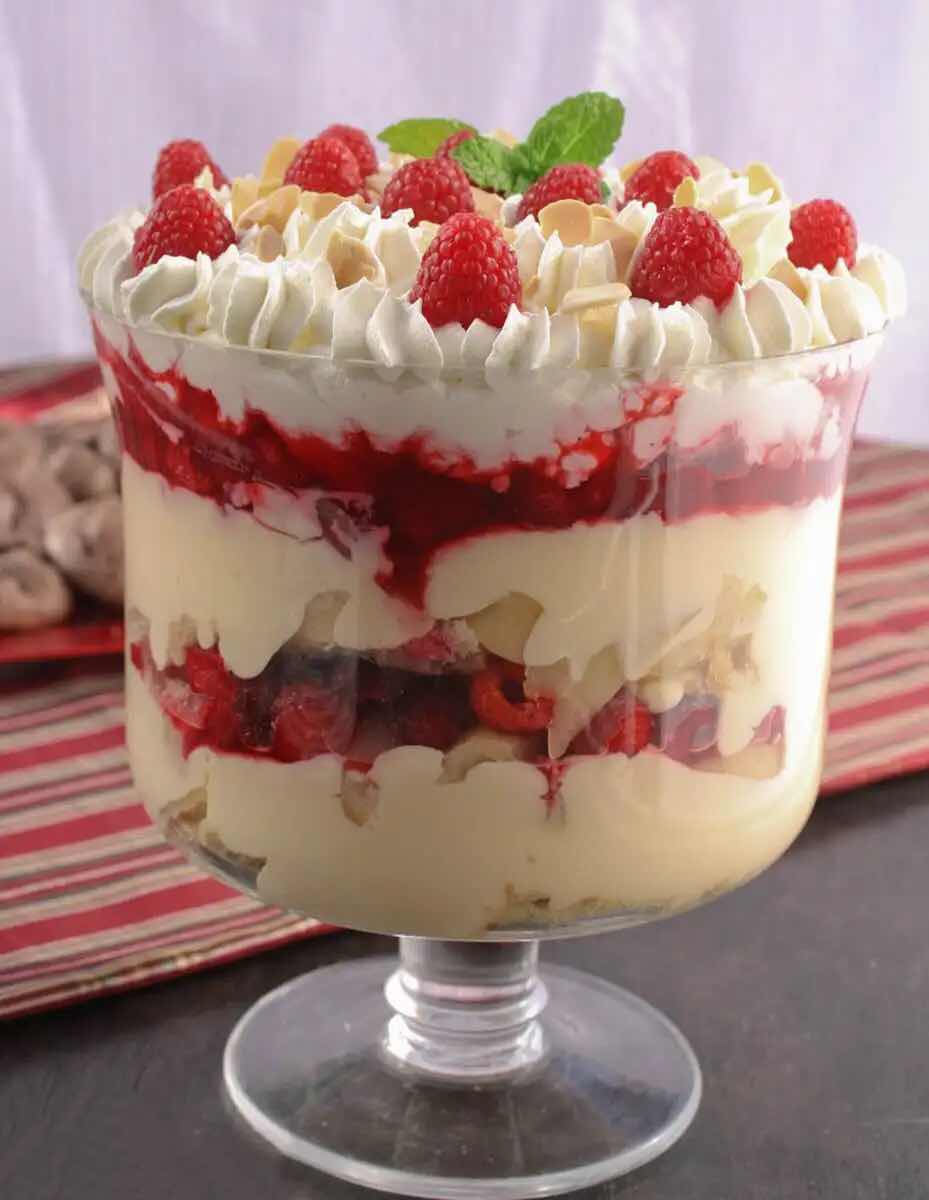
Assemble the Trifle
Place 1/3 of the cake cubes in the bottom of the trifle dish, jam side up.
Top the cake cubes with 1/3 of the fruit, followed by 1/3 of the custard and finally with 1/3 of the whipped cream. Repeat layers two more times.
Decorate the top with fresh fruit.
Keep chilled until ready to serve.