Pumpkin pie is popular in the United States and Canada, but in other parts of the world, not so much.
1621 – Early American settlers of Plimoth Plantation (1620-1692), the first permanent European settlement in southern New England, might have made pumpkin pies (of sorts) by making stewed pumpkins or by filling a hollowed out shell with milk, honey and spices, and then baking it in hot ashes.
An actual present-day pumpkin pie with crust is a myth, as ovens to bake pies were not available in the colony at that stage.
Northeastern Native American tribes grew squash and pumpkins.
They roasted or boiled them for eating. Historians think that the settlers were not very impressed by the Indians’ squash and/or pumpkins until they had to survive their first harsh winter when about half of the settlers died from scurvy and exposure.
The Native Americans brought pumpkins as gifts to the first settlers, and taught them the many used for the pumpkin.
This is what developed into pumpkin pie about 50 years after the first Thanksgiving in America.
1651 – Francois Pierre la Varenne, the famous French chef and author of one of the most important French cookbooks of the 17th century, wrote a cookbook called Le Vrai Cuisinier Francois (The True French Cook).
It was translated and published in England as The French Cook in 1653.
It has a recipe for a pumpkin pie that included the pastry:
Tourte of pumpkin – Boile it with good milk, pass it through a straining pan very thick, and mix it with sugar, butter, a little salt and if you will, a few stamped almonds; let all be very thin. Put it in your sheet of paste; bake it. After it is baked, besprinkle it with sugar and serve.
As for our Pumpkin Pie recipe, if you give it a try, we do hope you enjoy it.
Ingredients
Crust
¼cup butter, softened
¼cup shortening
1¼cups all-purpose flour
1Tbsp granulated sugar
¼tsp salt
1egg yolk
2Tbsp ice water
Filling
3eggs
115 oz can pumpkin
½cup granulated sugar
¼cup packed dark brown sugar
1tsp ground cinnamon
½tsp salt
½tsp ground ginger
¼tsp ground cloves
¼tsp ground nutmeg
¾cup whole milk
¼cup heavy cream
Directions
Crust
Beat together butter and shortening until smooth and creamy.
Chill till firm
Sift together flour, sugar and salt in medium bowl
Using a pastry knife or fork, cut the chilled butter and shortening into the dry ingredients until the flour is mixed in and it has a crumbly texture.
Mix egg yolk and ice water into the dough with a spoon then form it into a ball with your hands.
Don't work the dough too much or your crust will lose its flakiness.
Flakey crust is good crust.
Cover dough ball with plastic wrap to sit until the filling is ready.
Filling
Beat eggs.
Add pumpkin and stir well to combine
Combine sugars, cinnamon, salt, ginger, cloves, and nutmeg in a small bowl.
Stir spice mixture into the pumpkin.
Mix in milk and cream.
Preheat oven to 425 degrees.
While oven preheats let filling sit so that it can come closer to room temperature.
Unwrap pie dough, then roll it flat on a floured surface and line a 9 inch pie dish.
When oven is hot pour filling into pie shell, and bake for 15 minutes. Reduce heat to 350 and bake for another 50 to 60 minutes or until a knife stuck in the middle comes out clean.
Cool pie, then chill. Slice chilled pie into 6 pieces to serve restaurant size portions. Whipped cream on top is optional but highly recommended.
Here’s a conversion chart, just in case:

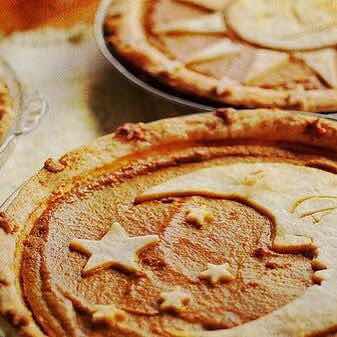
If you feel artsy,
you can design a moon and stars pie crust top.
Cut your design and bake it.
Allow to cool and place on top of your cooled pumpkin pie.