
Left to heal on its own, a cold sore will usually disappear without a lot of drama.
The blister will break, scab over, and eventually fall off.
But by popping the blister the healing process self destructs and can lead to several problems, like:
A cold sore goes through five stages:
Stage 1: Tingling and itching occurs about 24 hours before blisters erupt.
Stage 2: Fluid-filled blisters appear.
Stage 3: The blisters burst, ooze, and form painful sores.
Stage 4: The sores dry out and scab over causing itching and cracking.
Stage 5: The scab falls off and the cold sore heals.



Aloe vera is a popular treatment for burns, but did you know that the clear gel from this succulent can also work as a cold sore remedy?
Aloe vera contains enzymes which promote fast and natural healing, so if you have an aloe vera plant, just break off a leaf, wash it thoroughly, then split it lengthwise to expose the inside sticky part of the plant.
Dab the gel on your cold sore throughout the day to relieve pain and discomfort.
If you don’t have an aloe plant, you can use pure aloe gel purchased at the store or online, just make sure it’s 100% aloe gel.








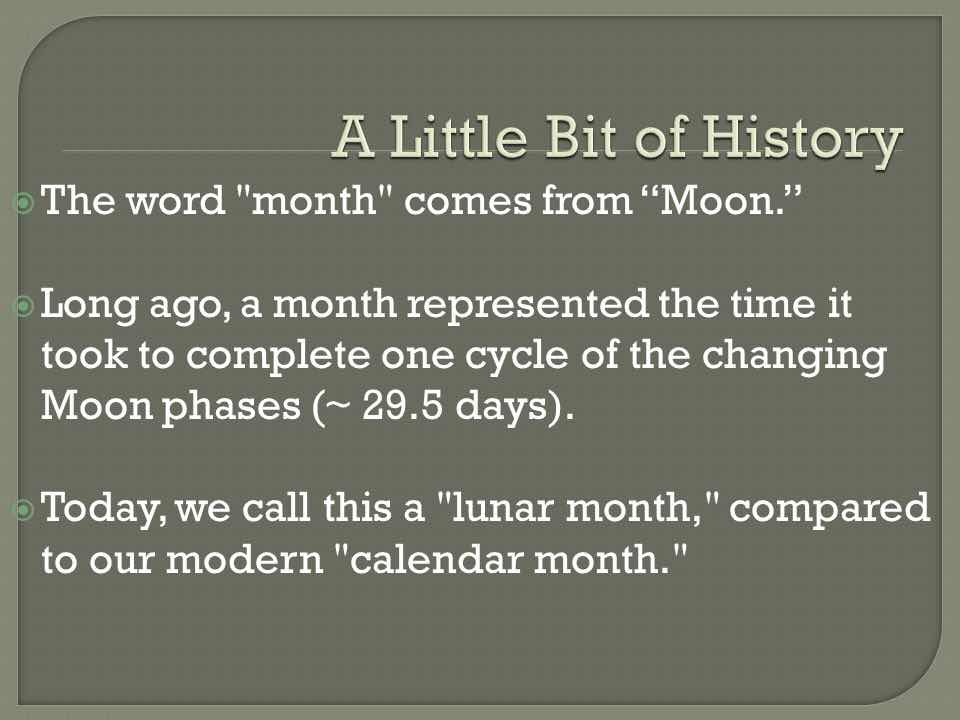
The word “Month” comes from the word “Moon”
Throughout history, people have used different types of calendars to help them know when to plant crops, choose the best hunting times, plan meetings and observe religious holidays.
All calendars work by making it possible for you to organize time units by observing astronomical cycles. Months are based on the moon's orbit around the Earth, years are based Earth's orbit around the sun and days depend on how fast the Earth revolves around its axis.
Solar Calendars and the Sun
Solar calendars, such as the Gregorian calendar, track time using tropical years.
A tropical year, also called a solar year, is the length of time between two vernal equinoxes.
That time period is 365 days, five hours, 48 minutes and 46 seconds.
Many people refer to a vernal equinox is the first day of spring.
There is no U.S. law that forces people to observe Gregorian solar calendar dates.
The use of that calendar dates back to 1751 when the United Kingdom told its colonies to use the Gregorian calendar.
Lunar Phases and New Moons
A new moon is the opposite of a full moon.
As the moon orbits the Earth, its position relative to the Earth and sun changes, and the moon appears to go through phases.
When the Earth sits between the moon and sun, people on Earth see a full moon at night.
A new moon occurs when the moon sits between the sun and the Earth.
New moons occur during the day, so you can't see them because of the sun's brightness.
A quarter moon, on the other hand, occurs when the moon completes 25 percent of its orbit around this planet.
Lunar Calendars
Because the moon circles the Earth in the same time it takes to rotate once, the moon always shows one face to the Earth. That's why you never see its far side.
A new moon occurs every 29.5 days. Astronomers call the time between new moons a synodic month.
All lunar calendars that people create base their months on the synodic month rather than the months you find on a solar calendar.
JANUARY-Named for the Roman god Janus,’ god of doorways’ and beginnings. (Remember the Pope opened the ‘Holy Door’ on Jan. 1 2000?)January is man’s beginnings not God’s.
The holy bible reveals that God’s new year is around March 21 when the spring equinox occurs.
FEBRUARY– Named for the Roman festival of purification ‘Februa’.
The first day of the Carnival season is always January 6th (which is twelve days after Christmas).
This is called the Twelfth Night (Kings Night) and marks the beginning of the private masked balls that are held until Mardi Gras Day.
Mardi Gras Day (Which is always Fat Tuesday.) is the last and greatest day of the carnival season before their 40 days of lent.
MARCH– Named for the Roman God Mars, who was the god of war and guardian of the state.
Mars was the father of Romulus and Remus.
APRIL– From the Roman calendar month of Aprilis.
Considered a scared month for the goddess Venus.
April also comes from the Latin word aperire meaning “to open” refering to a spring season, opening of the flowers and leaves.
MAY– Named for the goddess Maia, the daughter of Atlas and one of the “Seven Sisters” of the Pleiades.
JUNE– Named for the goddess Juno, wife of Jupiter and queen of the heavens and gods
JULY– Named for Julius Caesar in 44 BC.
The month originally had the Roman name of Quintilis (meaning five).
AUGUST– Named for the Roman Emperor Augustus in 8 BC.
The month was formerly known as Sextilis (meaning six).
SEPTEMBER– From the Latin word “septem” meaning seven, which was the seventh month of the calendar. (Yet we use it as the ninth month?)
OCTOBER– From the Latin word “octo” meaning eight, which was the eight month of the calendar. (Yet we use it as the tenth month?)
NOVEMBER– From the Latin word “novem” meaning nine, which was the ninth month of the calendar. (Yet we use it as the eleventh month?)
DECEMBER– From the Latin word decem meaning ten, which was the tenth month of the calendar. (Yet we use it as the twelfth month?)